

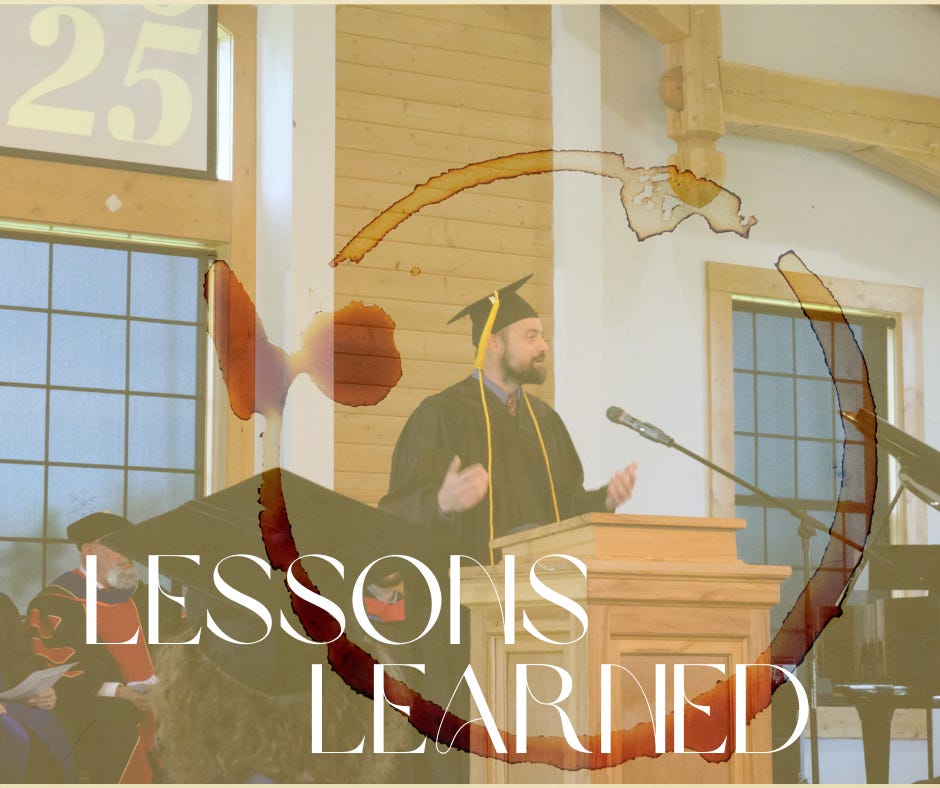
There is something about suffering that rips aside that which is not divine and leaves a divine interchange of love, not self, at the center of all things.
—Gene Edwards
Caution with the calling
Nearly seven years ago, I left a photojournalism career to pursue a strong sense of calling God placed on me. He called me to enroll at a small Christian College in Billings, Montana. I didn’t know to what end this entailed, but I did have a where.
A few months later, I brushed up on high school math (I lost most of what I learned during my 13-year gap year) and we moved my one-year-old daughter and wife to Billings, Montana. I began orientation in the fall of 2018 as the oldest student at 32.
As I nervously applied myself the the new rhythms of academics, work, and family, God imprinted a verse in my mind that I learned to keep in my heart:
… knowledge puffs up, but love builds up. If anyone imagines that he knows something, he does not yet know as he ought to know.
1 Cor. 8:1-2
God was telling me, “Justin, you are about to learn new and exciting things, but this will not matter if you do not love and encourage others.”
Yet as I sought to learn how to love others biblically, I was surprised to discover that God would use people as the primary method of teaching me to know His love for me, along with how to love others.
Eventually, after some tribulations, I learned to experience His grace every day. 1
Lessons from a Desert Disciple
During a Church Ministry Leadership class, I was assigned Well-Intentioned Dragons, by Marshall Shelley. This book tells gut-wrenching stories collected from pastors who endured the hardship of being attacked by their flock. I was amazed at how common the sheep turn on their shepherd, their minister. Why?
Shelley does a tremendous job unpacking the reason for what he calls “dragon blights” and how to navigate the challenges they impose on the ministry.
This alone makes this book worthwhile for anyone going into church ministry; however, it was the epilogue that stuck with me:
Pachomius was a soldier in fourth-century Egypt when he became a Christian. He followed in the steps of Palamon, an ascetic hermit who taught self-denial and solitary life. Palamon believed holiness was attained through isolation. In fact, he was so obsessed with removing himself from the world, he and his followers erected a giant column upon which he lived, ate, and slept.
Ironically, this spectacle drew crowds of people who asked for wisdom and advice from the man who sought to isolate himself.2
However, upon seeing this spectacle, Pachomius questioned the lifestyle, teaching, and methods of his mentor. He asked,
“How can you learn to love if no one else is around?
“How can you learn humility living alone?
“How can you learn kindness or gentleness or goodness in isolation?
“How can you learn patience unless someone puts yours to the test?
“He concluded that discovering Christian virtues demands other people—ordinary, ornery people.
Further, Shelley asserts, “True love isn’t even learned among friends we have chosen.” Rather, “We learn agape love most effectively in our involuntary associations (people we cannot choose).”
Eventually, Pachomius established the Koinonia monastic life to learn and practice the virtues in community.
Learning Love by Receiving Hardship
The Story of Pachomius and his early monastic community impressed on me the value of receiving the hardship of people and practicing the virtues in the communities in which God placed me.
As I interned at an established church, I learned and practiced grace to people older than me who had different perspectives, values, and expectations. Naturally, I did or said things to which parishioners took an exception … and some were more blunt than others in their communication of their disapproval.
As I continued to study at Montana Bible College, I eventually stepped into a student leader role, God used the challenges I experienced to help me experience his grace. Some students slandered me behind my back, and I would find out about it later via the grapevine.
But this is the beautiful thing about the “involuntary associations” God places in our lives. While we are more likely to be hurt and frustrated by them, God uses them to drive us to God.
Pachomius discovered this in his new order of Koinonia—a community of flawed people. Conflicts arose, and words were exchanged. But, Shelley pointed out:
“They discovered that disagreements and opposition proved the opportunity to redeem life situations and experience God’s grace.”
Of course, this is a pious posture to take. There is a hint of ‘Just turn the other cheek and carry on’ kind of vibe. And I don’t blame you if you’re feeling this at this part of the post.
However, the goal of suffering, hardships, and difficult people isn’t to adopt a Romans 8:28 mindset. (I’m too blessed to be stressed, et al.) Rather, the goal is to allow ourselves to fully experience it and run to Jesus in desperation. Because during the heat of suffering, Romans 8:28 is a cruel and senseless passage.
God is interested in the results of suffering. He wants you to know just how hurt He was when He loved you, died for you, and saved you. He continues to love you and me despite the hurt the world gives Him.
It is through people that God teaches us his economy of love and grace. Because we see just how much He has done for us. Therefore, we draw upon Him for strength, grace, and love.
This is vital for anyone going into Ministry.
Because Ministry—if we distill it to the core— is incarnating Christ’s love to people, messy and broken people.
A Continual Challenge
We know it is terribly important that the Christian worker be broken. If for no other reason, we need to be reassured that one who can speak so eloquently of Christ really loves him. Does he love the Lord enough to still love him when all his gifts, which helped him make Christ so attractive, are taken away from him? Will he love the Lord when he has nothing?
— Gene Edwards, The Inward Journey
What causes me to shudder as I contemplate these truths is that I have suffered very few tribulations from people. Reading stories of the trials that the persecuted church experiences every day leaves my heart weeping. Reading Marshall Shelley’s book causes my blood to boil.
I recognize that I have a long way to go in learning God’s economy of love and the blessing that comes with suffering.
Therefore, I have learned to embrace whatever hardship comes my way as I follow Christ in obedience.
Therefore, reader, I pray that you recognize that every difficult person that God places in your life is not an obstacle to your ministry—they are the ministry!
We are not called to only love those who agree with us, think like us, and have nice manners.
But also those who irritate and annoy.
Those who gossip and slander.
Those who vote differently.
These are the people who expose our sinful attitudes.
These are the people who cause us to run to Jesus and cling to His feet as a rock and refuge.
And as we do this, we learn to forgive, as we have been forgiven; to reconcile, as we have been reconciled; and love unconditionally.
Why?
Because Jesus. As we do these things, we are actually incarnating Jesus’ presence and love among others.
Jesus loved the most. He was hurt the most.
On the night of his betrayal, Jesus looked around the room and studied each of His disciples. They were the trail mix variety of followers: tax collectors, fishermen, and religious zealots. They argued and irritated each other. In a few hours, one would betray Jesus. Another would deny Him. All would abandon Him during His arrest, trial, and crucifixion.
Yet Jesus took off his outer garments, washed the disciples’ feet, then commanded them to do likewise.
He told them: “Love one another. As I have loved you, so you must love one another. By this everyone will know that you are my disciples, if you love one another.” John 13:34-35
Jesus suffered. He loved those who hurt Him.
Why wouldn’t His followers expect anything else?
I want to place a big asterisks to say my objective here is not to rehash people drama pertaining to Bible College. I have read stories like this in which the author portrays him/herself as a self-proclaimed martyr-sufferer or a self-righteous vicim. This is not my goal. Rather, I want to highlight God’s faithfulness and goodness in growing me and preparing individuals for ministry.
I hope you find encouragement in this story.
Shelley claimed that this is the origin of the expression, “put someone on a pedestal.”
Great insights in this article, Justin.
Thank you!